
Heart checkup: insight into your heart and vessel values
An extensive blood test with 12 heart and vessel values — the full cholesterol profile, Apo(B), Lp(a), hsCRP, homocysteine and blood sugar — for insight into your heart and vessel health.
Add to your order
No referral needed
Added to your order
Click the button to view your cart
Included values
12 valuesTotal Cholesterol, LDL Cholesterol, HDL Cholesterol, Non-HDL Cholesterol, Cholesterol/HDL Ratio, Triglycerides, ApoB (Apolipoprotein B), Lipoprotein(a), hs-CRP (High Sensitivity CRP), Glucose (Fasting), HbA1c (Glycated Hemoglobin), Creatinine
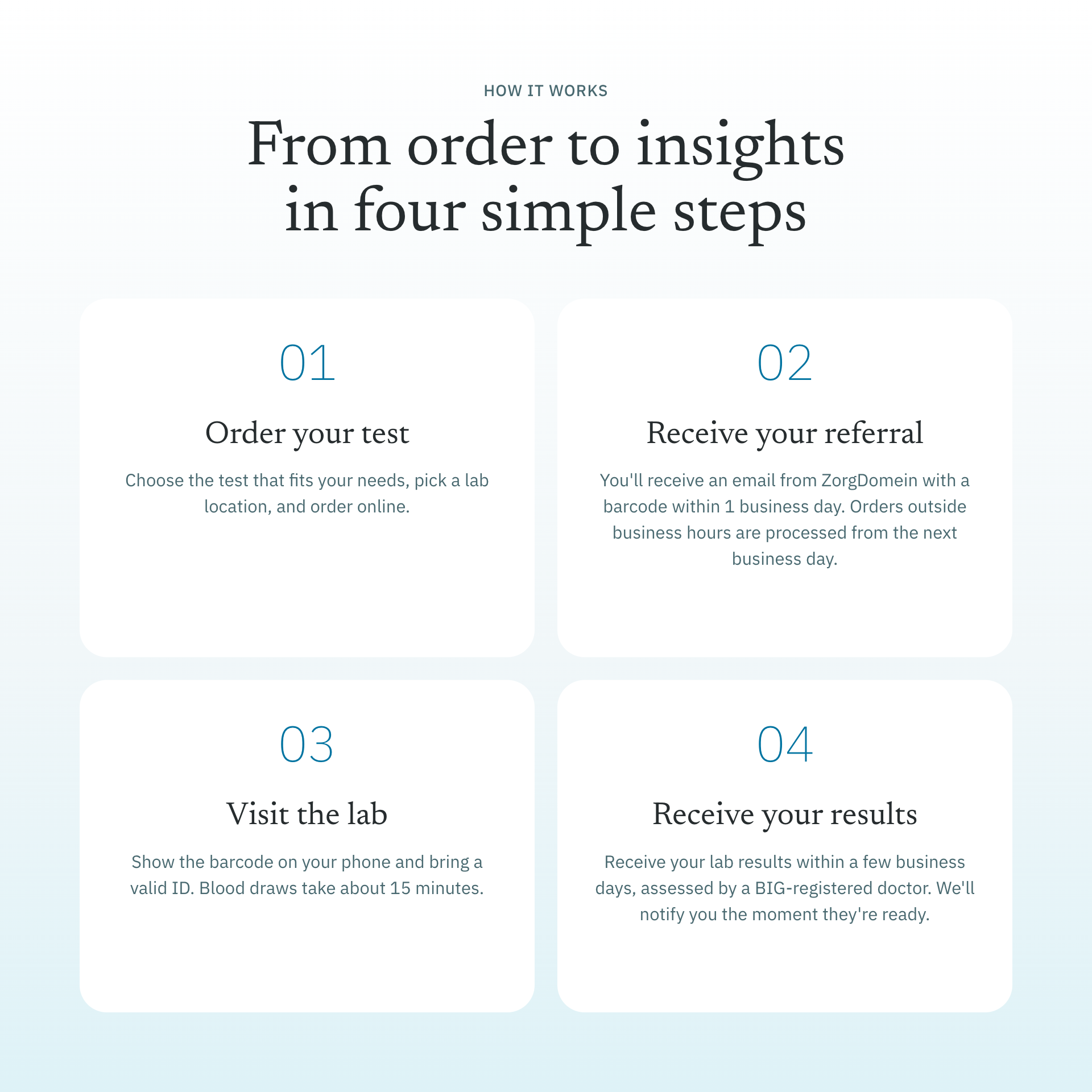
Your Health Journey in 4 Simple Steps
From order to insights, we've made health testing as easy as it should be.
Order Your Test
Choose the test that fits your needs, pick a lab location, and order online.
Receive Your Referral
You'll receive an email from ZorgDomein with a barcode within 1 business day. Orders outside business hours are processed from the next business day.
Visit the Lab
Show the barcode on your phone and bring a valid ID. Blood draws take about 15 minutes.
Receive Your Results
Receive your lab results within a few business days, assessed by a BIG-registered doctor. We'll notify you the moment they're ready.
Order Your Test
Choose the test that fits your needs, pick a lab location, and order online.
Receive Your Referral
You'll receive an email from ZorgDomein with a barcode within 1 business day. Orders outside business hours are processed from the next business day.
Visit the Lab
Show the barcode on your phone and bring a valid ID. Blood draws take about 15 minutes.
Receive Your Results
Receive your lab results within a few business days, assessed by a BIG-registered doctor. We'll notify you the moment they're ready.
Always a location near you
With 700+ certified phlebotomy points across the Netherlands.
What this checkup measures
This checkup includes 12 values for a clear picture of this system.
| No. | Biomarker | Unit | Turnaround |
|---|---|---|---|
| 01 | Total Cholesterol Total cholesterol measures the combined amount of HDL, LDL, and VLDL cholesterol in your blood. It provides an overview of your lipid status but should be interpreted alongside individual components for a complete cardiovascular risk picture. | mmol/l | 1 day |
| 02 | LDL Cholesterol LDL cholesterol is the amount of cholesterol carried inside LDL particles, the particles that can build up in the artery wall. That is where its nickname comes from: the bad cholesterol. Two things rarely appear on a report. First, in a routine lipid panel LDL is usually not measured but calculated from your total cholesterol, your HDL and your triglycerides. Second, the 3.0 mmol/l upper limit is a population reference interval, not a target. What counts as a good LDL for you is decided by your overall cardiovascular risk, not by the line printed on the page. | mmol/l | 1 day |
| 03 | HDL Cholesterol HDL cholesterol is the amount of cholesterol carried inside the HDL particles in your blood. Those particles pick cholesterol up from your tissues and from the artery wall and take it back to the liver. That transport is what earned HDL the nickname good cholesterol. The nickname is misleading. HDL is above all a mirror of your metabolism: the value drops with excess weight, insulin resistance, smoking and inactivity, and it is those factors that carry the risk. Drugs that raise HDL substantially do not reduce the number of cardiovascular events. And more is not always better: at very high values, mortality in large population studies turns back upwards. So never read your HDL on its own. It only takes on meaning alongside your triglycerides, your LDL and your overall risk profile. | mmol/l | 1 day |
| 04 | Non-HDL Cholesterol Non-HDL cholesterol is your total cholesterol minus your HDL cholesterol. What remains is the cholesterol carried inside every particle that can lodge in an artery wall: LDL, IDL, VLDL, the remnant particles left after fat digestion, and Lp(a). One number, in other words, for the entire atherogenic burden, and no extra test is needed to obtain it. The strength of non-HDL lies in what it does not need. No formula is involved and you do not have to fast. Precisely where a calculated LDL becomes unreliable, with high triglycerides or after a meal, non-HDL still holds. The upper limit of 3.3 mmol/l printed on your result is a population reference value, not a target. What counts as a good value for you depends on your risk profile. | mmol/l | — |
| 05 | Cholesterol/HDL Ratio The cholesterol/HDL ratio is your total cholesterol divided by your HDL. The number summarises how your favourable and unfavourable cholesterol relate to each other. A lower ratio points to a more favourable profile and a lower cardiovascular risk. Learn what your value can mean. | mol/mol | — |
| 06 | Triglycerides Triglycerides are the most common type of fat in the body, used for energy storage. Elevated levels may be associated with increased risk of cardiovascular disease, especially when combined with other lipid abnormalities. | mmol/l | 1 day |
| 07 | ApoB (Apolipoprotein B) Apolipoprotein B (ApoB) is the main protein on LDL and other atherogenic lipoproteins. Each atherogenic particle carries exactly one ApoB molecule, making it a precise measure of the total number of particles that can contribute to plaque formation. | g/l | 4 days |
| 08 | Lipoprotein(a) Lp(a), in full lipoprotein(a), is an LDL-like particle with an extra protein bolted onto it: apolipoprotein(a). That single extra protein makes the particle more damaging to the artery wall than an ordinary LDL particle. What makes Lp(a) unusual is that its level is more than 90 percent written into your DNA. It is set by the LPA gene, fixed early in life, and barely changes afterwards. Diet, exercise and weight loss shift the value hardly at all. That is why European consensus recommends measuring Lp(a) at least once in the life of every adult. A single test usually suffices: you learn a number that will not change again. | g/l | 6 days |
| 09 | hs-CRP (High Sensitivity CRP) High-Sensitivity CRP (hs-CRP) measures very low levels of C-Reactive Protein in the blood. It is primarily used to assess cardiovascular risk by detecting low-grade chronic inflammation. | mg/l | 3 days |
| 10 | Glucose (Fasting) Fasting glucose measures the level of sugar (glucose) in your blood after an overnight fast. It is one of the primary tests used to screen for and monitor diabetes and pre-diabetes. | mmol/l | 1 day |
| 11 | HbA1c (Glycated Hemoglobin) HbA1c (glycated haemoglobin) reflects your average blood sugar levels over the past 2-3 months. It is the gold standard for long-term blood sugar monitoring and diabetes management. | mmol/mol | 2 days |
| 12 | Creatinine Creatinine is a waste product that is continuously produced in your muscles. The kidneys filter it out of the blood and remove it in urine. The blood creatinine level is therefore a core number for kidney function. In Dutch it is written both as creatinine and as kreatinine. Because production depends on your muscle mass, the same figure reads differently per person. A raised creatinine does not automatically point to a kidney problem. This page explains what high and low values can mean. It also covers the everyday things that shift the result temporarily. | umol/l | 1 day |
| Your result arrives once the slowest test is finished: 6 days. This is indicative; turnaround varies per laboratory. | |||
Preparation
-
Been ill? Wait a little
RequiredHad a fever, an infection or a vaccination in the past 2 weeks? Wait with the draw until you are fully recovered. These values react to inflammation and would give a distorted picture.
-
Better no hard training beforehand
RecommendedHard exercise in the 48 hours before can raise this value temporarily. Plan the draw on a rest day if you can.
-
No alcohol beforehand
RequiredDrink no alcohol in the 24 hours before the draw.
-
Come fasting
RequiredFrom 22:00 the evening before, eat and drink nothing except water. That is at least 8 hours. Skip coffee, tea, chewing gum and smoking that morning. Plan the draw before 10:00.
- Water is always fine. Drink as usual beforehand, it makes the draw easier.
- Take your usual medication, unless your own doctor told you otherwise.
Extend this panel
Tests from the same field, run on the same sample. Same draw, no second appointment.
Related checkups
Discover more checkups for a fuller picture of your health.
Liver checkup
A blood test with 9 liver values — ALT, AST, GGT, alkaline phosphatase, bilirubin and albumin — for insight into how your liver is functioning.
Kidney checkup
A blood test with 5 kidney values — creatinine, eGFR, uric acid, sodium and potassium — for insight into how your kidneys are functioning.
Thyroid checkup
A blood test with 4 thyroid values — TSH, free T4, free T3 and anti-TPO — for insight into how your thyroid is functioning.
This test not quite right?
Build your own blood test from 51+ individual biomarkers — choose exactly what you need.
Have a question?
Our team is happy to help. Ask your question and we'll respond as soon as possible.