Liver checkup: insight into your liver values
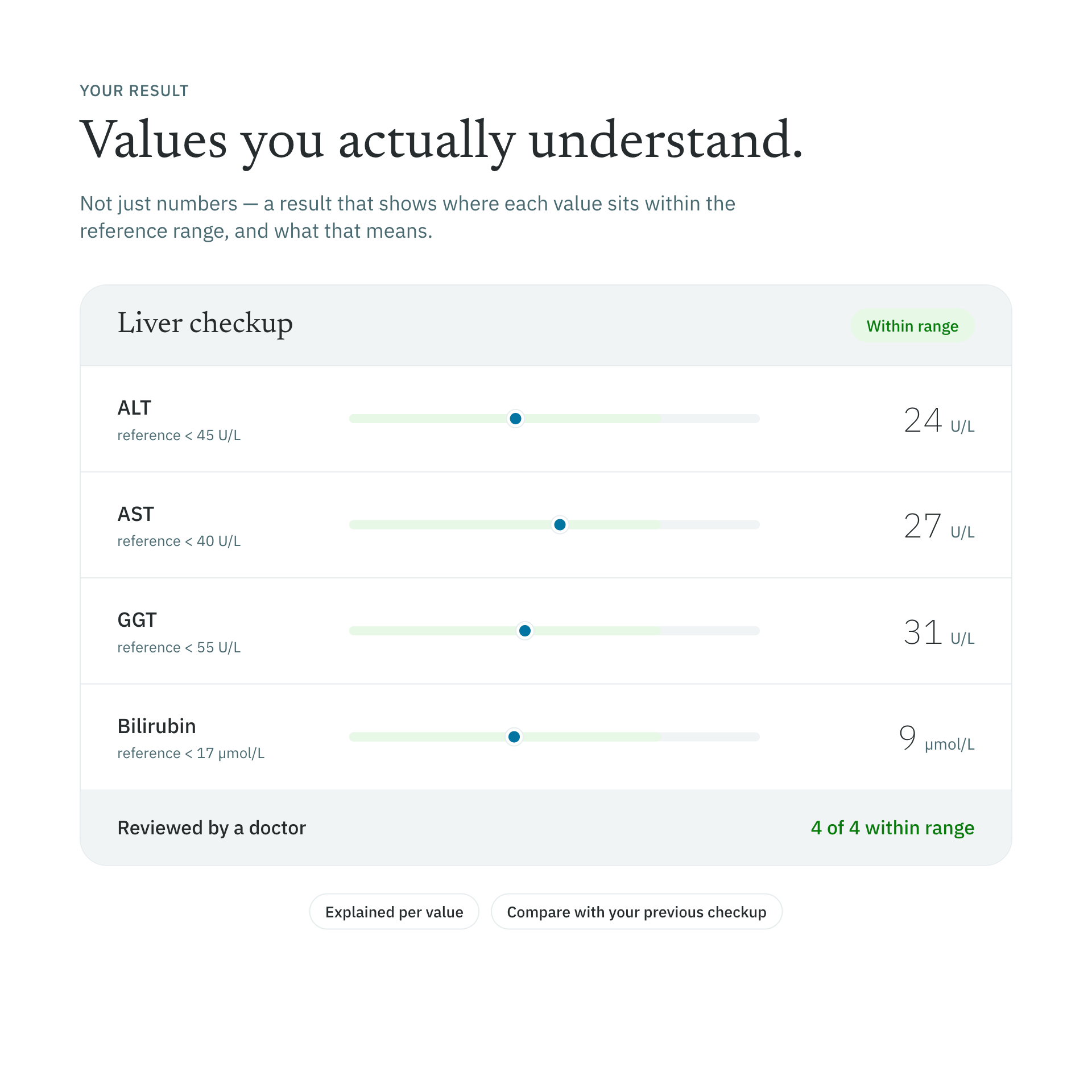
A blood test with 9 liver values — ALT, AST, GGT, alkaline phosphatase, bilirubin and albumin — for insight into how your liver is functioning.
Add to your order
No referral needed
Added to your order
Click the button to view your cart
Included values
9 valuesALT (Alanine Aminotransferase), AST (Aspartate Aminotransferase), GGT (Gamma-Glutamyl Transferase), ALP (Alkaline Phosphatase), Bilirubin (Total), Albumin, Platelets (Thrombocytes), Bilirubin (Direct), Bilirubin (Indirect)
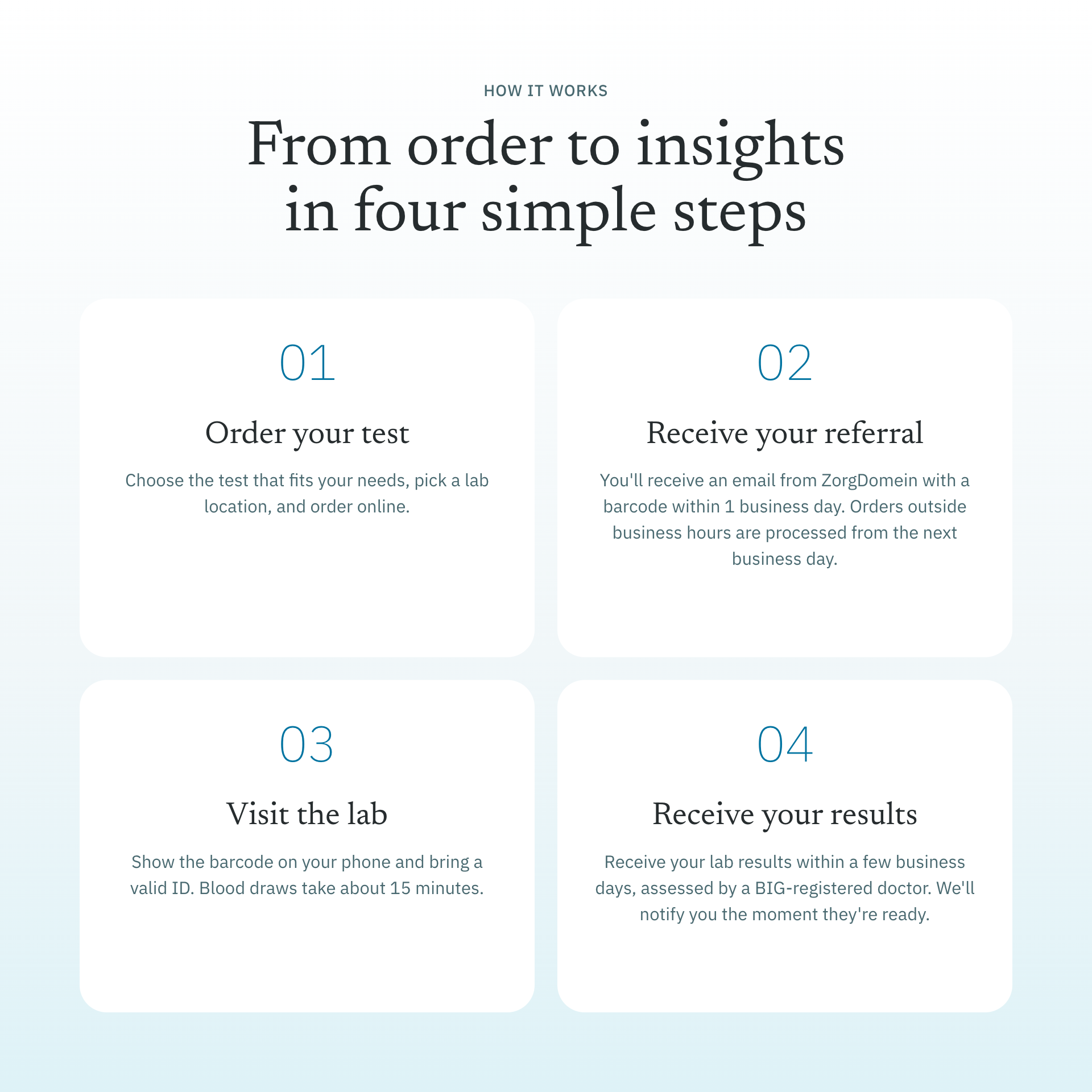
Your Health Journey in 4 Simple Steps
From order to insights, we've made health testing as easy as it should be.
Order Your Test
Choose the test that fits your needs, pick a lab location, and order online.
Receive Your Referral
You'll receive an email from ZorgDomein with a barcode within 1 business day. Orders outside business hours are processed from the next business day.
Visit the Lab
Show the barcode on your phone and bring a valid ID. Blood draws take about 15 minutes.
Receive Your Results
Receive your lab results within a few business days, assessed by a BIG-registered doctor. We'll notify you the moment they're ready.
Order Your Test
Choose the test that fits your needs, pick a lab location, and order online.
Receive Your Referral
You'll receive an email from ZorgDomein with a barcode within 1 business day. Orders outside business hours are processed from the next business day.
Visit the Lab
Show the barcode on your phone and bring a valid ID. Blood draws take about 15 minutes.
Receive Your Results
Receive your lab results within a few business days, assessed by a BIG-registered doctor. We'll notify you the moment they're ready.
Always a location near you
With 700+ certified phlebotomy points across the Netherlands.
What this checkup measures
This checkup includes 9 values for a clear picture of this system.
| No. | Biomarker | Unit | Turnaround |
|---|---|---|---|
| 01 | ALT (Alanine Aminotransferase) Your ALT value shows how much alanine aminotransferase is in your blood. This enzyme sits mainly in the liver. That makes ALT the most liver-specific of the routine enzymes. When it reaches the blood, liver cells have been damaged. In adult men the reference range runs to 45 u/l, and in women to 34 u/l. A mildly raised result is common and has several causes. Fatty liver leads that list, well ahead of alcohol and hepatitis. | u/l | 1 day |
| 02 | AST (Aspartate Aminotransferase) Your AST value shows how much aspartate aminotransferase is circulating in your blood. It is an enzyme that leaks out whenever cells are damaged. AST sits in the liver, but equally in skeletal muscle, heart muscle, kidneys, brain and red blood cells. That is why a raised AST is not, on its own, a liver value. A hard training session the day before explains the result more often than liver disease does. The reference range runs up to 35 u/l in men and 31 u/l in women. What the number means only becomes clear alongside ALT, gamma-GT and CK. | u/l | 1 day |
| 03 | GGT (Gamma-Glutamyl Transferase) GGT (gamma-glutamyl transferase) is a liver and bile duct enzyme that serves as one of the most sensitive markers for hepatobiliary disorders. It is particularly responsive to alcohol consumption and may be elevated in bile duct obstruction, liver disease, and with certain medications. | u/l | 1 day |
| 04 | ALP (Alkaline Phosphatase) Alkaline phosphatase, usually shortened to ALP on a report, is an enzyme found in almost every tissue. Two sources account for nearly all of what reaches the blood. The first is the liver, and within it mainly the cells lining the small bile ducts. The second is bone, where the enzyme is released as new bone tissue is built. A raised result therefore does not yet say where the rise came from. That question is not answered by this one number. It is answered by the values beside it, by your age and by your situation. | u/l | 1 day |
| 05 | Bilirubin (Total) Total bilirubin measures the combined amount of direct and indirect bilirubin in your blood. Bilirubin is a waste product formed during the normal breakdown of red blood cells, and elevated levels may indicate liver disease, bile duct problems, or increased red blood cell destruction. | umol/l | 4 days |
| 06 | Albumin Albumin is the most abundant protein in the blood, produced by the liver. It maintains fluid balance, transports hormones and nutrients, and serves as an indicator of liver and kidney function. | g/l | 2 days |
| 07 | Platelets (Thrombocytes) Platelets are the smallest particles in your blood. They are what closes a small wound again. The platelet count tells you how many are circulating per litre of blood. In adults the usual range runs from 150 to 400 x10⁹/l. That range is the same for men and women. Reference values differ between laboratories. The range printed on your own report is the one that counts. The figure comes from the same tube as your haemoglobin and your white cells. An unusual result rarely means something is wrong on its own. Inflammation, an iron shortfall or the tube itself can shift it. | 10^9/l | 1 day |
| 08 | Bilirubin (Direct) Direct (conjugated) bilirubin is the water-soluble form of bilirubin that has been processed by the liver. Elevated levels may indicate bile duct obstruction or liver disease and are an important component of liver function assessment. | umol/l | 2 days |
| 09 | Bilirubin (Indirect) Indirect bilirubin is the part of your bilirubin that your liver has not yet processed. The value is not measured separately but calculated: your total bilirubin minus your direct bilirubin, in the same unit. That split helps to show where an abnormal total is coming from. This page explains what your indirect bilirubin result can mean. | umol/l | — |
| Your result arrives once the slowest test is finished: 4 days. This is indicative; turnaround varies per laboratory. | |||
Preparation
-
No hard training beforehand
RequiredNo heavy training, long endurance sessions or anything that leaves you out of breath in the 48 hours before the draw. Normal walking is fine.
-
Better no alcohol beforehand
RecommendedAlcohol in the 24 hours before can raise this value. Better skip it that evening.
- Water is always fine. Drink as usual beforehand, it makes the draw easier.
- Take your usual medication, unless your own doctor told you otherwise.
Extend this panel
Tests from the same field, run on the same sample. Same draw, no second appointment.
Related checkups
Discover more checkups for a fuller picture of your health.
Kidney checkup
A blood test with 5 kidney values — creatinine, eGFR, uric acid, sodium and potassium — for insight into how your kidneys are functioning.
Thyroid checkup
A blood test with 4 thyroid values — TSH, free T4, free T3 and anti-TPO — for insight into how your thyroid is functioning.
Heart checkup
An extensive blood test with 12 heart and vessel values — the full cholesterol profile, Apo(B), Lp(a), hsCRP, homocysteine and blood sugar — for insight into your heart and vessel health.
This test not quite right?
Build your own blood test from 51+ individual biomarkers — choose exactly what you need.
Have a question?
Our team is happy to help. Ask your question and we'll respond as soon as possible.