
General blood test: your health, system by system
A broad blood test covering 18 values across liver, kidneys, thyroid, heart, vitamins and blood count.
Add to your order
No referral needed
Added to your order
Click the button to view your cart
Included values
18 valuesALT (Alanine Aminotransferase), GGT (Gamma-Glutamyl Transferase), Creatinine, eGFR (Estimated Glomerular Filtration Rate), TSH (Thyroid Stimulating Hormone), Total Cholesterol, HDL Cholesterol, LDL Cholesterol, Triglycerides, Glucose (Fasting), Vitamin D (25-OH), Vitamin B12, Ferritin, Hemoglobin, Leukocytes (WBC), Platelets (Thrombocytes), CRP (C-Reactive Protein), MCV (Mean Corpuscular Volume)
A blood test measures substances in your blood that reveal how your organs are working. This general blood test covers 18 values across six systems. You do not need a referral. A BIG-registered doctor reviews your results.
What does a blood test actually measure?
Your blood passes every organ. Along the way each organ leaves traces: enzymes, waste products, hormones and building blocks. A blood test measures those traces.
So a raised liver enzyme tells you something about your liver, even when you feel nothing. The same holds for every system in this panel.
Six systems in one draw
Most single tests look at one organ. This test looks at six at once:
- Liver, via ALT and Gamma-GT
- Kidneys, via creatinine and eGFR
- Thyroid, via TSH
- Heart and blood vessels, via cholesterol, triglycerides and glucose
- Vitamins and iron, via vitamin D, vitamin B12 and ferritin
- Blood count and inflammation, via haemoglobin, white cells, platelets, MCV and CRP
Looking broadly is exactly what gives you a good picture of your general health.
The 18 values in full
You get these values back:
- ALT, Gamma-GT
- Creatinine, eGFR
- TSH
- Total cholesterol, HDL, LDL, triglycerides
- Glucose (fasting)
- Vitamin D (25-OH), vitamin B12, ferritin
- Haemoglobin, white cells, platelets, MCV
- CRP
Together, the cholesterol group and your glucose say something about your cardiovascular risk. That is one of the few risk estimates ordinary blood can give you.
What a blood test does not show
Blood values are a snapshot. They do not tell you everything.
A normal result does not rule a condition out. And a value outside the reference range often means nothing is wrong. Reference ranges also differ between laboratories.
That is why a doctor is involved, and why your results come with an explanation.
Booking an appointment and giving blood
You order the test online. After that you can book an appointment at a collection point near you.
Staff take blood from your arm, which takes a few minutes. We work with independent, certified laboratories across the Netherlands, and those laboratories run the collection points.
Your results, reviewed by a doctor
Your results appear in your own account. Every result carries a professional assessment by a BIG-registered doctor.
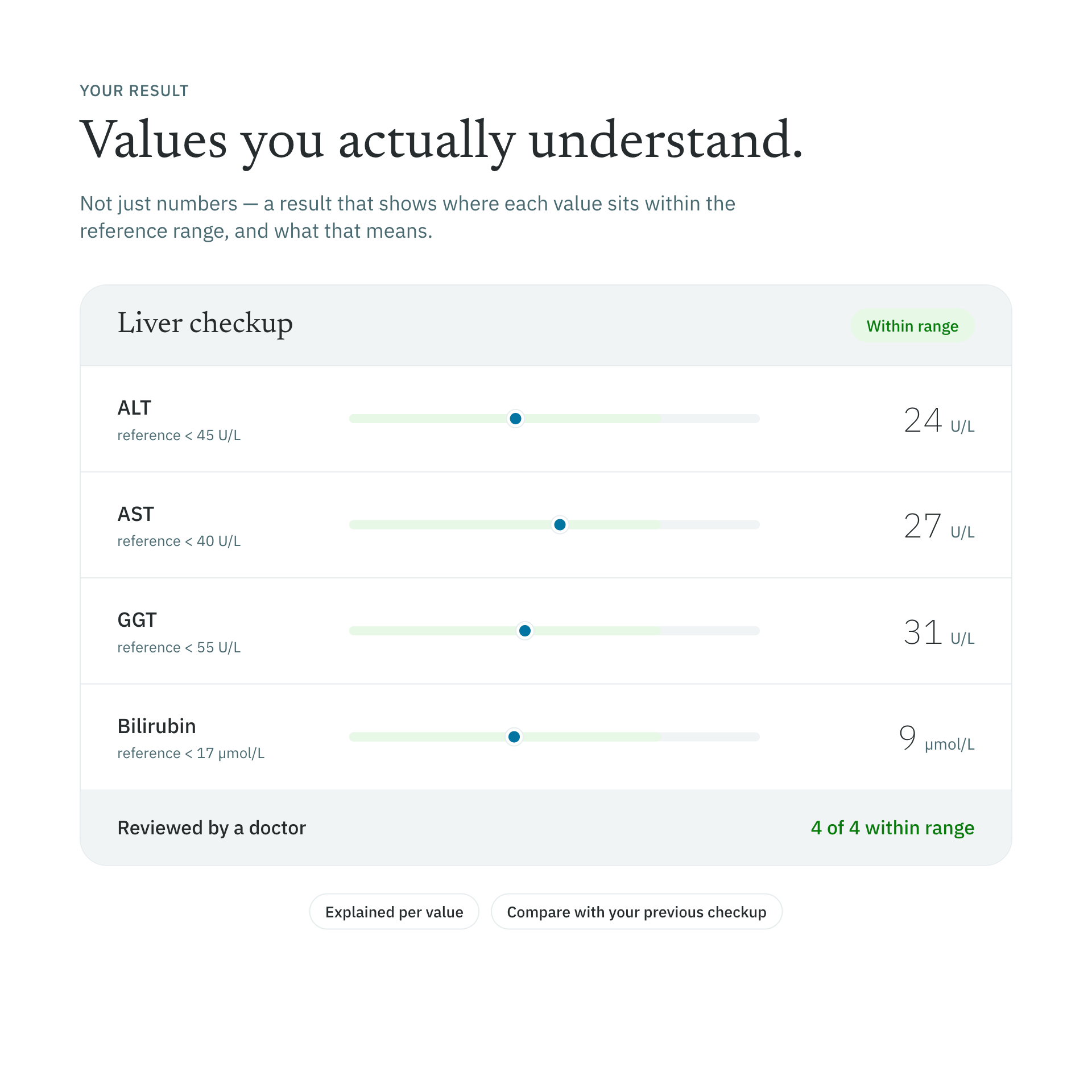
You see where each value sits and what that means. Planning to change anything about your treatment? Take your results to your GP first.
When is a blood test worth doing?
A blood test helps when you have a question blood can answer. For example:
- you have been tired for weeks with no clear reason
- you want to know where you stand on cardiovascular risk
- conditions run in your family
- you changed something in your diet, training or medication
- you want a starting point to compare against later
That last one is underrated. A single measurement only says so much. Put a second one beside it a year later, and you see a direction.
Arrange it yourself, or go through your GP?
Either works. The difference is who asks the question and who pays.
Your GP requests a blood test when there is a medical reason. That goes through your health insurance and counts towards your deductible.
Ordering it yourself works without symptoms too. You pay for it yourself and your deductible stays untouched. You give blood at the same certified laboratories. The doctor assessment is the same as well.
Do you have symptoms that worry you? See your GP first. A blood test does not replace a consultation.
Start broad, or go deeper on one system?
Already know where your question sits? Then a targeted test makes more sense than a broad blood test. We have one per system:
No specific question, and you simply want to know where you stand? Then start broad, with this test.
Frequently asked questions about blood tests
That depends on which values are measured. This panel covers your liver, kidneys and thyroid. It also covers your lipids, glucose, vitamin D, vitamin B12, iron and your blood count. Blood shows how organs work right now, but it is not a scan.
TSH is the standard first step, and it is included here. If TSH points to a problem, free T4 and sometimes antibodies usually follow. To look at your thyroid more broadly straight away, choose the separate thyroid test.
Does your GP request it? Then it usually goes through your health insurance and counts towards your deductible. Order it here and you pay 199 euro yourself, leaving your deductible untouched. We cannot guarantee reimbursement.
Ours is this general blood test, with 18 values across six systems. Broader is not always better. The more values you measure, the greater the chance of a chance outlier. That outlier means nothing.
No. You arrange the test yourself online and no GP is involved.
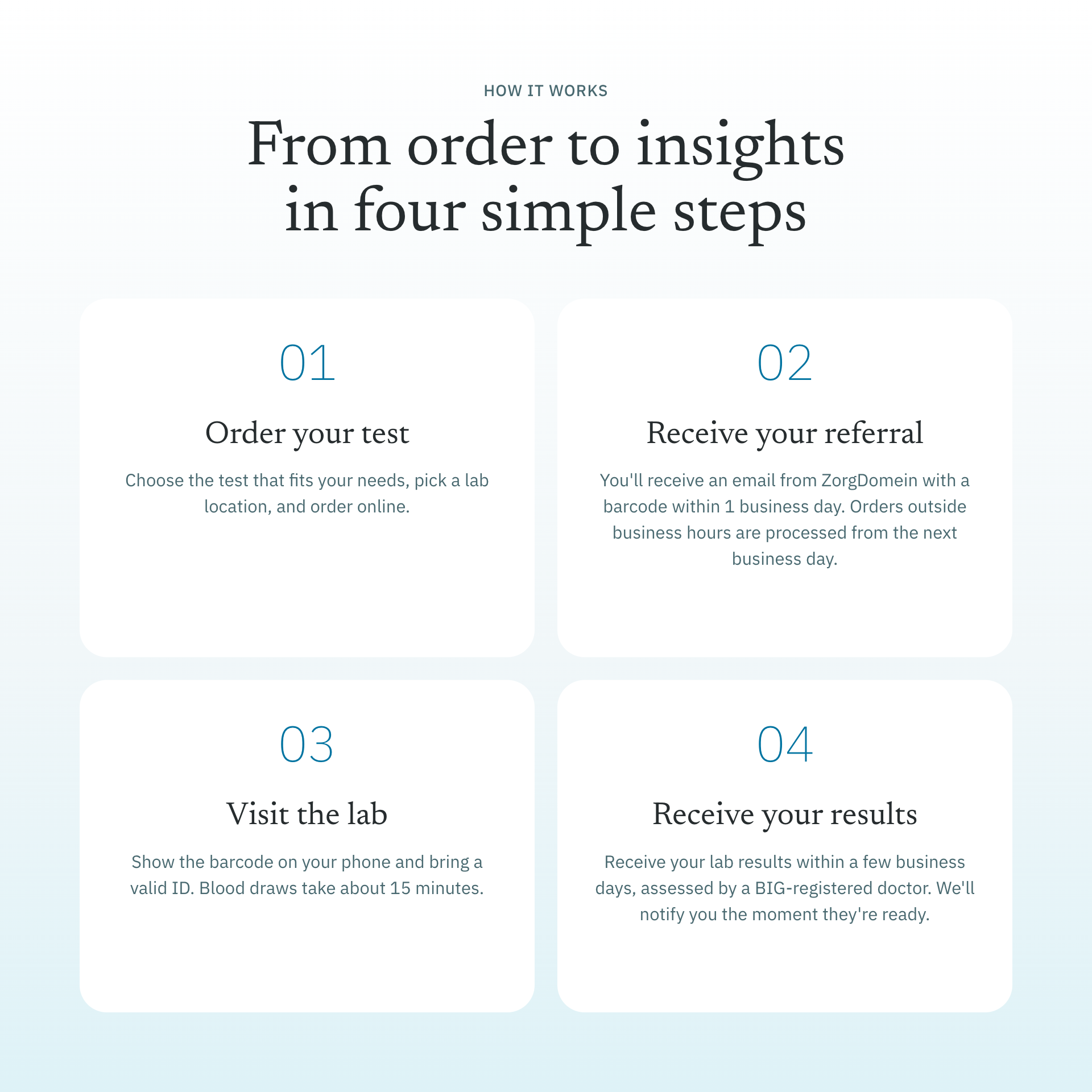
Your Health Journey in 4 Simple Steps
From order to insights, we've made health testing as easy as it should be.
Order Your Test
Choose the test that fits your needs, pick a lab location, and order online.
Receive Your Referral
You'll receive an email from ZorgDomein with a barcode within 1 business day. Orders outside business hours are processed from the next business day.
Visit the Lab
Show the barcode on your phone and bring a valid ID. Blood draws take about 15 minutes.
Receive Your Results
Receive your lab results within a few business days, assessed by a BIG-registered doctor. We'll notify you the moment they're ready.
Order Your Test
Choose the test that fits your needs, pick a lab location, and order online.
Receive Your Referral
You'll receive an email from ZorgDomein with a barcode within 1 business day. Orders outside business hours are processed from the next business day.
Visit the Lab
Show the barcode on your phone and bring a valid ID. Blood draws take about 15 minutes.
Receive Your Results
Receive your lab results within a few business days, assessed by a BIG-registered doctor. We'll notify you the moment they're ready.
Always a location near you
With 700+ certified phlebotomy points across the Netherlands.
What this checkup measures
This checkup includes 18 values for a clear picture of this system.
| No. | Biomarker | Unit | Turnaround |
|---|---|---|---|
| 01 | ALT (Alanine Aminotransferase) Your ALT value shows how much alanine aminotransferase is in your blood. This enzyme sits mainly in the liver. That makes ALT the most liver-specific of the routine enzymes. When it reaches the blood, liver cells have been damaged. In adult men the reference range runs to 45 u/l, and in women to 34 u/l. A mildly raised result is common and has several causes. Fatty liver leads that list, well ahead of alcohol and hepatitis. | u/l | 1 day |
| 02 | GGT (Gamma-Glutamyl Transferase) GGT (gamma-glutamyl transferase) is a liver and bile duct enzyme that serves as one of the most sensitive markers for hepatobiliary disorders. It is particularly responsive to alcohol consumption and may be elevated in bile duct obstruction, liver disease, and with certain medications. | u/l | 1 day |
| 03 | Creatinine Creatinine is a waste product that is continuously produced in your muscles. The kidneys filter it out of the blood and remove it in urine. The blood creatinine level is therefore a core number for kidney function. In Dutch it is written both as creatinine and as kreatinine. Because production depends on your muscle mass, the same figure reads differently per person. A raised creatinine does not automatically point to a kidney problem. This page explains what high and low values can mean. It also covers the everyday things that shift the result temporarily. | umol/l | 1 day |
| 04 | eGFR (Estimated Glomerular Filtration Rate) eGFR (estimated glomerular filtration rate) is a calculated measure of how effectively your kidneys filter waste from the blood. It is the gold standard for diagnosing and staging chronic kidney disease and is derived from blood creatinine or cystatin C levels along with demographic factors. | ml/min/1,73m² | 1 day |
| 05 | TSH (Thyroid Stimulating Hormone) TSH is thyroid-stimulating hormone. The pituitary gland makes it, and uses it to drive your thyroid. At the laboratory that runs the test the usual adult range runs from 0.27 to 4.20 mE/L. A high TSH usually fits an underactive thyroid. A low value usually fits an overactive one. That direction feels inverted, and it is. TSH is the pituitary signal, not the thyroid hormone itself. Laboratories use slightly different limits from one another. Always read the reference value printed on your own result. And a single measurement is never a diagnosis. | mu/l | 2 days |
| 06 | Total Cholesterol Total cholesterol measures the combined amount of HDL, LDL, and VLDL cholesterol in your blood. It provides an overview of your lipid status but should be interpreted alongside individual components for a complete cardiovascular risk picture. | mmol/l | 1 day |
| 07 | HDL Cholesterol HDL cholesterol is the amount of cholesterol carried inside the HDL particles in your blood. Those particles pick cholesterol up from your tissues and from the artery wall and take it back to the liver. That transport is what earned HDL the nickname good cholesterol. The nickname is misleading. HDL is above all a mirror of your metabolism: the value drops with excess weight, insulin resistance, smoking and inactivity, and it is those factors that carry the risk. Drugs that raise HDL substantially do not reduce the number of cardiovascular events. And more is not always better: at very high values, mortality in large population studies turns back upwards. So never read your HDL on its own. It only takes on meaning alongside your triglycerides, your LDL and your overall risk profile. | mmol/l | 1 day |
| 08 | LDL Cholesterol LDL cholesterol is the amount of cholesterol carried inside LDL particles, the particles that can build up in the artery wall. That is where its nickname comes from: the bad cholesterol. Two things rarely appear on a report. First, in a routine lipid panel LDL is usually not measured but calculated from your total cholesterol, your HDL and your triglycerides. Second, the 3.0 mmol/l upper limit is a population reference interval, not a target. What counts as a good LDL for you is decided by your overall cardiovascular risk, not by the line printed on the page. | mmol/l | 1 day |
| 09 | Triglycerides Triglycerides are the most common type of fat in the body, used for energy storage. Elevated levels may be associated with increased risk of cardiovascular disease, especially when combined with other lipid abnormalities. | mmol/l | 1 day |
| 10 | Glucose (Fasting) Fasting glucose measures the level of sugar (glucose) in your blood after an overnight fast. It is one of the primary tests used to screen for and monitor diabetes and pre-diabetes. | mmol/l | 1 day |
| 11 | Vitamin D (25-OH) Vitamin D is a fat-soluble vitamin. Its main job is the absorption of calcium and phosphate from the gut. That makes it decisive for bone metabolism. The skin produces it under the influence of sunlight. Food and supplements supply a smaller share. | nmol/l | 3 days |
| 12 | Vitamin B12 Vitamin B12 is considered essential for red blood cell formation, neurological function, and DNA synthesis. Deficiency may develop gradually and is sometimes associated with dietary patterns. Healthcare providers can help interpret your results. | pmol/l | 3 days |
| 13 | Ferritin Ferritin is a protein that stores iron, so your ferritin level shows how large your iron reserve is. Serum iron only measures how much iron is circulating in your blood at that moment; ferritin describes the reserve behind it. That reserve empties before your haemoglobin falls, so a low ferritin can already cause symptoms while your blood count still looks normal. Ferritin also rises with inflammation, infection and liver strain, which is why it can only be read properly alongside a CRP. Commonly used reference values are 30 to 400 µg/l for men and 15 to 150 µg/l for women, but your own laboratory report is what counts. | ug/l | 2 days |
| 14 | Hemoglobin A hemoglobin test measures the amount of hemoglobin protein in your blood. Hemoglobin is found inside red blood cells and is responsible for binding oxygen in the lungs and delivering it throughout your body. | mmol/l | 1 day |
| 15 | Leukocytes (WBC) Leukocytes are the white blood cells in your blood. They form the core of your defence against bacteria, viruses and fungi. The leukocyte count states how many of these cells sit in a fixed volume of blood. The number is the sum of five different cell types, each with its own task. At the laboratory that runs the test the usual adult range runs from 4.3 to 10.0 x10^9/L. Laboratories use slightly different limits from one another. Always read the reference value printed on your own result. A single measurement is not a diagnosis. The number moves with infection, exertion, stress, smoking and even the time of day you give blood. | 10^9/l | 1 day |
| 16 | Platelets (Thrombocytes) Platelets are the smallest particles in your blood. They are what closes a small wound again. The platelet count tells you how many are circulating per litre of blood. In adults the usual range runs from 150 to 400 x10⁹/l. That range is the same for men and women. Reference values differ between laboratories. The range printed on your own report is the one that counts. The figure comes from the same tube as your haemoglobin and your white cells. An unusual result rarely means something is wrong on its own. Inflammation, an iron shortfall or the tube itself can shift it. | 10^9/l | 1 day |
| 17 | CRP (C-Reactive Protein) C-Reactive Protein (CRP) is a protein produced by the liver in response to inflammation. It is a general marker of inflammation and can rise rapidly during infections, injuries, or chronic inflammatory conditions. | mg/l | 2 days |
| 18 | MCV (Mean Corpuscular Volume) MCV stands for mean corpuscular volume: the average volume of one red blood cell, expressed in femtolitres. In adults an MCV between 80 and 100 fL is normal. Below 80 fL your red cells are small, which usually points to iron deficiency or to an inherited trait. Above 100 fL they are large, which fits a vitamin B12 or folate deficiency, regular alcohol use, an underactive thyroid or liver disease. MCV makes no diagnosis of its own: it indicates the direction in which to look further. And because it is an average, the value can be normal while two deficiencies exist side by side. | fl | 1 day |
| Your result arrives once the slowest test is finished: 3 days. This is indicative; turnaround varies per laboratory. | |||
Preparation
-
Been ill? Wait a little
RequiredHad a fever, an infection or a vaccination in the past 2 weeks? Wait with the draw until you are fully recovered. These values react to inflammation and would give a distorted picture.
-
Pause biotin
RequiredDo you take a supplement with biotin (vitamin B8, common in hair, skin and nail supplements)? Stop it 72 hours before the draw. Biotin interferes with the measurement of these values.
-
Better no hard training beforehand
RecommendedHard exercise in the 48 hours before can raise this value temporarily. Plan the draw on a rest day if you can.
-
No alcohol beforehand
RequiredDrink no alcohol in the 24 hours before the draw.
-
Come fasting
RequiredFrom 22:00 the evening before, eat and drink nothing except water. That is at least 8 hours. Skip coffee, tea, chewing gum and smoking that morning. Plan the draw before 10:00.
-
Timing worth knowing
Good to knowIf you repeat this test, pick the same time of day each time so the results compare.
- Water is always fine. Drink as usual beforehand, it makes the draw easier.
- Take your usual medication, unless your own doctor told you otherwise.
Extend this panel
Tests from the same field, run on the same sample. Same draw, no second appointment.
Related checkups
Discover more checkups for a fuller picture of your health.
Liver checkup
A blood test with 9 liver values — ALT, AST, GGT, alkaline phosphatase, bilirubin and albumin — for insight into how your liver is functioning.
Kidney checkup
A blood test with 5 kidney values — creatinine, eGFR, uric acid, sodium and potassium — for insight into how your kidneys are functioning.
Thyroid checkup
A blood test with 4 thyroid values — TSH, free T4, free T3 and anti-TPO — for insight into how your thyroid is functioning.
This test not quite right?
Build your own blood test from 51+ individual biomarkers — choose exactly what you need.
Have a question?
Our team is happy to help. Ask your question and we'll respond as soon as possible.