
Blood count checkup: insight into your blood count and immune system
A blood test with 10 values for blood count and immunity — haemoglobin, haematocrit, white cells with differential, platelets, MCV, MCH, MCHC, CRP and ESR — for insight into blood and inflammation.
Add to your order
No referral needed
Added to your order
Click the button to view your cart
Included values
11 valuesHemoglobin, Hematocrit, Leukocytes (WBC), Leukocyte Differential, Platelets (Thrombocytes), MCV (Mean Corpuscular Volume), MCH (Mean Corpuscular Hemoglobin), MCHC (Mean Corpuscular Hemoglobin Concentration), CRP (C-Reactive Protein), Erythrocytes (RBC), Ferritin
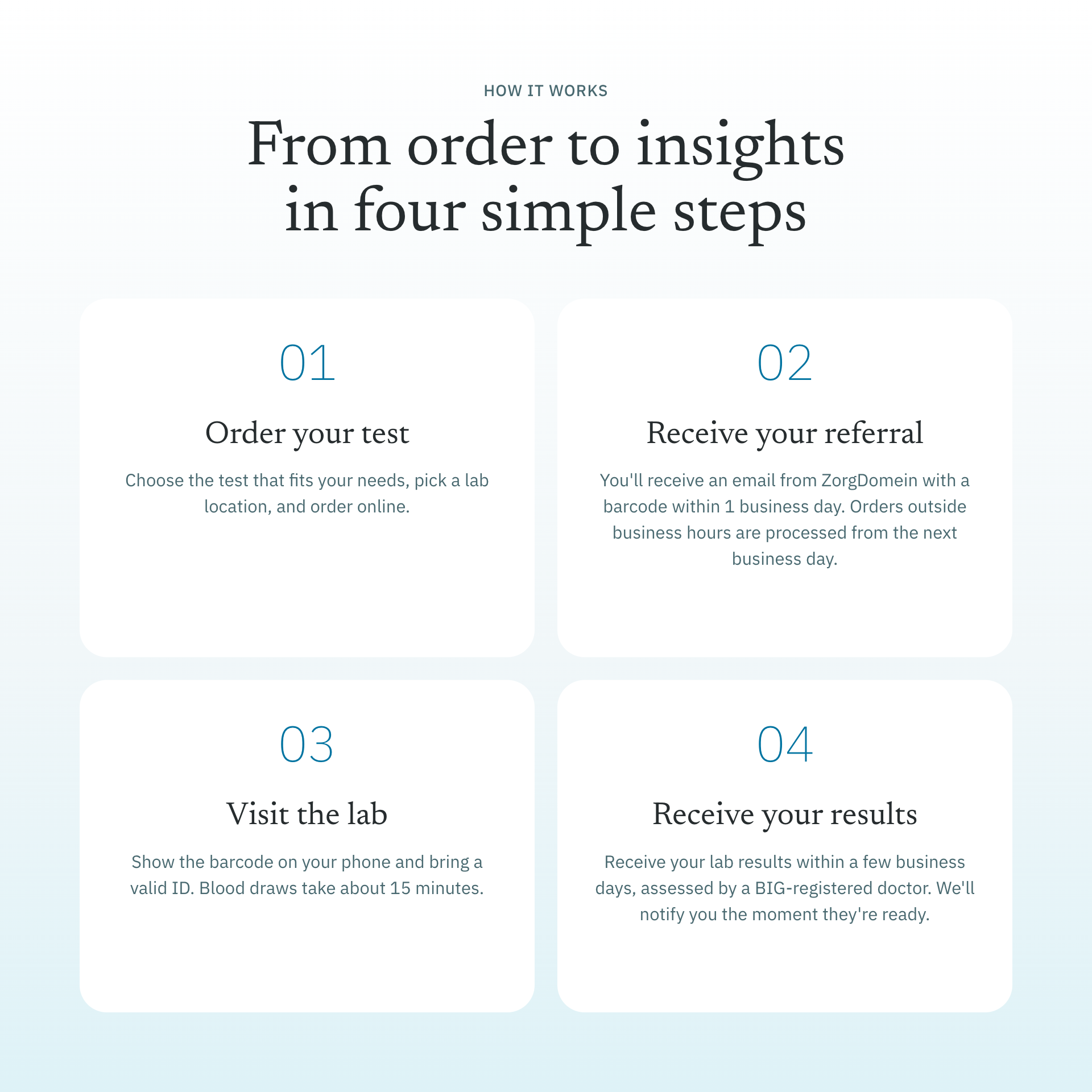
Your Health Journey in 4 Simple Steps
From order to insights, we've made health testing as easy as it should be.
Order Your Test
Choose the test that fits your needs, pick a lab location, and order online.
Receive Your Referral
You'll receive an email from ZorgDomein with a barcode within 1 business day. Orders outside business hours are processed from the next business day.
Visit the Lab
Show the barcode on your phone and bring a valid ID. Blood draws take about 15 minutes.
Receive Your Results
Receive your lab results within a few business days, assessed by a BIG-registered doctor. We'll notify you the moment they're ready.
Order Your Test
Choose the test that fits your needs, pick a lab location, and order online.
Receive Your Referral
You'll receive an email from ZorgDomein with a barcode within 1 business day. Orders outside business hours are processed from the next business day.
Visit the Lab
Show the barcode on your phone and bring a valid ID. Blood draws take about 15 minutes.
Receive Your Results
Receive your lab results within a few business days, assessed by a BIG-registered doctor. We'll notify you the moment they're ready.
Always a location near you
With 700+ certified phlebotomy points across the Netherlands.
What this checkup measures
This checkup includes 11 values for a clear picture of this system.
| No. | Biomarker | Unit | Turnaround |
|---|---|---|---|
| 01 | Hemoglobin A hemoglobin test measures the amount of hemoglobin protein in your blood. Hemoglobin is found inside red blood cells and is responsible for binding oxygen in the lungs and delivering it throughout your body. | mmol/l | 1 day |
| 02 | Hematocrit Your hematocrit shows which share of your blood consists of red blood cells. Dutch laboratories report it as a fraction. A result of 0.45 l/l therefore stands for 45 percent. Hematocrit is almost always measured alongside haemoglobin and the red cell count. It is a concentration measure, so your fluid balance feeds into the result. Being under-hydrated raises the value without a single extra red cell being made. One isolated hematocrit value therefore says little. The number gains meaning next to your haemoglobin, your MCV and the timing of the draw. | l/l | 1 day |
| 03 | Leukocytes (WBC) Leukocytes are the white blood cells in your blood. They form the core of your defence against bacteria, viruses and fungi. The leukocyte count states how many of these cells sit in a fixed volume of blood. The number is the sum of five different cell types, each with its own task. At the laboratory that runs the test the usual adult range runs from 4.3 to 10.0 x10^9/L. Laboratories use slightly different limits from one another. Always read the reference value printed on your own result. A single measurement is not a diagnosis. The number moves with infection, exertion, stress, smoking and even the time of day you give blood. | 10^9/l | 1 day |
| 04 | Leukocyte Differential A leukocyte differential test measures the relative proportions of different types of white blood cells in your blood. It provides a detailed breakdown of your immune cell populations, offering valuable insight into your immune system's function. | — | 4 days |
| 05 | Platelets (Thrombocytes) Platelets are the smallest particles in your blood. They are what closes a small wound again. The platelet count tells you how many are circulating per litre of blood. In adults the usual range runs from 150 to 400 x10⁹/l. That range is the same for men and women. Reference values differ between laboratories. The range printed on your own report is the one that counts. The figure comes from the same tube as your haemoglobin and your white cells. An unusual result rarely means something is wrong on its own. Inflammation, an iron shortfall or the tube itself can shift it. | 10^9/l | 1 day |
| 06 | MCV (Mean Corpuscular Volume) MCV stands for mean corpuscular volume: the average volume of one red blood cell, expressed in femtolitres. In adults an MCV between 80 and 100 fL is normal. Below 80 fL your red cells are small, which usually points to iron deficiency or to an inherited trait. Above 100 fL they are large, which fits a vitamin B12 or folate deficiency, regular alcohol use, an underactive thyroid or liver disease. MCV makes no diagnosis of its own: it indicates the direction in which to look further. And because it is an average, the value can be normal while two deficiencies exist side by side. | fl | 1 day |
| 07 | MCH (Mean Corpuscular Hemoglobin) MCH is the average amount of haemoglobin in one red blood cell, calculated from your haemoglobin and red cell count. A low value often points to iron deficiency, a high value to a B12 or folate shortage. Learn what your MCH can mean. | fmol | — |
| 08 | MCHC (Mean Corpuscular Hemoglobin Concentration) MCHC is the average concentration of haemoglobin inside your red blood cells, calculated from your haemoglobin and haematocrit. A low value fits iron deficiency; a raised value is rare and usually checked before it is acted on. Learn what your MCHC can mean. | mmol/l | — |
| 09 | CRP (C-Reactive Protein) C-Reactive Protein (CRP) is a protein produced by the liver in response to inflammation. It is a general marker of inflammation and can rise rapidly during infections, injuries, or chronic inflammatory conditions. | mg/l | 2 days |
| 10 | Erythrocytes (RBC) An erythrocyte (red blood cell) count measures the number of red blood cells in your blood. Red blood cells are responsible for carrying oxygen from your lungs to the rest of your body and transporting carbon dioxide back for exhalation. | 10^12/l | 1 day |
| 11 | Ferritin Ferritin is a protein that stores iron, so your ferritin level shows how large your iron reserve is. Serum iron only measures how much iron is circulating in your blood at that moment; ferritin describes the reserve behind it. That reserve empties before your haemoglobin falls, so a low ferritin can already cause symptoms while your blood count still looks normal. Ferritin also rises with inflammation, infection and liver strain, which is why it can only be read properly alongside a CRP. Commonly used reference values are 30 to 400 µg/l for men and 15 to 150 µg/l for women, but your own laboratory report is what counts. | ug/l | 2 days |
| Your result arrives once the slowest test is finished: 4 days. This is indicative; turnaround varies per laboratory. | |||
Preparation
-
Been ill? Wait a little
RequiredHad a fever, an infection or a vaccination in the past 2 weeks? Wait with the draw until you are fully recovered. These values react to inflammation and would give a distorted picture.
-
Better no hard training beforehand
RecommendedHard exercise in the 48 hours before can raise this value temporarily. Plan the draw on a rest day if you can.
-
Preferably fasting
RecommendedComing fasting gives a slightly cleaner value, but it is not required. If it suits you, eat nothing from 22:00 the evening before and drink only water.
- Water is always fine. Drink as usual beforehand, it makes the draw easier.
- Take your usual medication, unless your own doctor told you otherwise.
Extend this panel
Tests from the same field, run on the same sample. Same draw, no second appointment.
Related checkups
Discover more checkups for a fuller picture of your health.
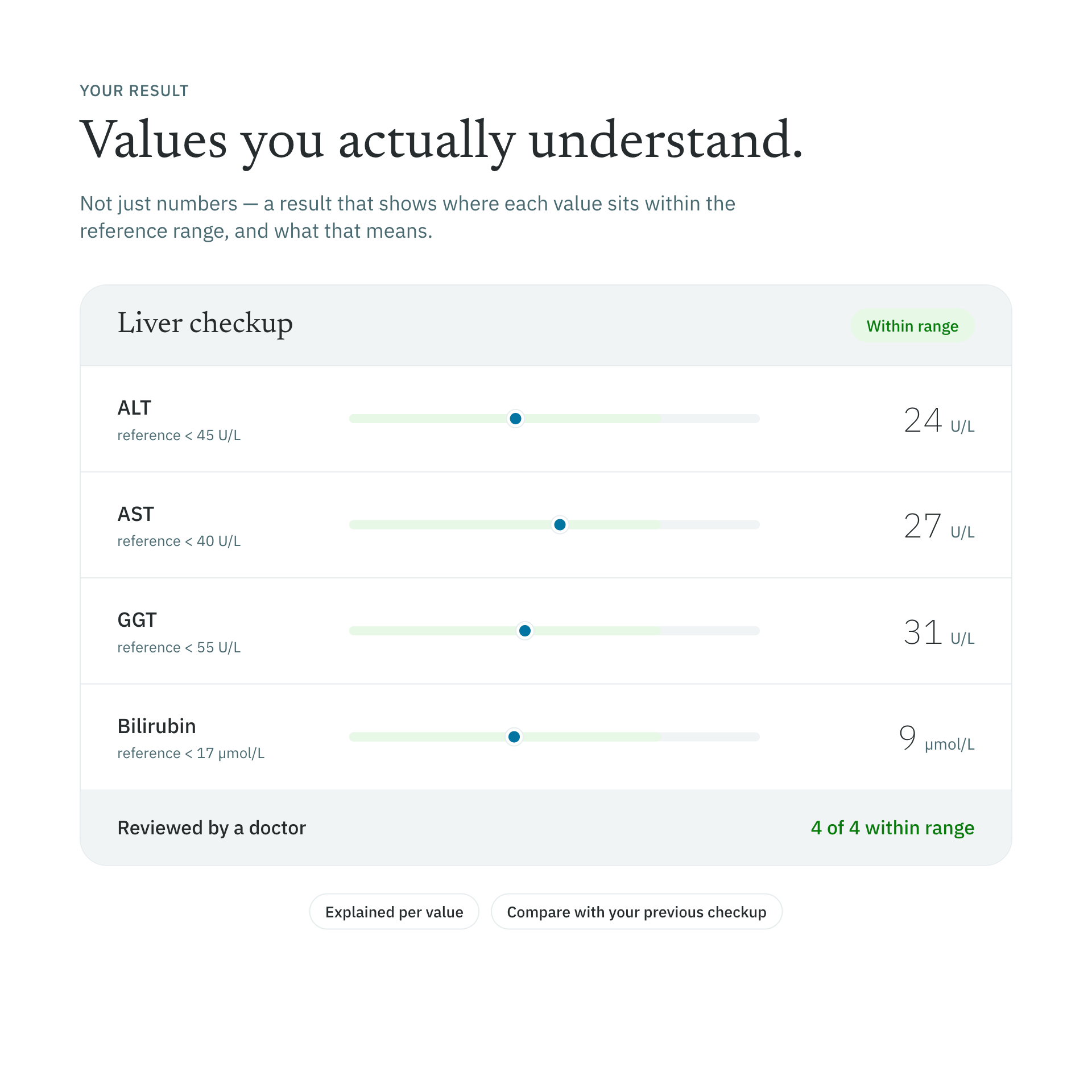
Liver checkup
A blood test with 9 liver values — ALT, AST, GGT, alkaline phosphatase, bilirubin and albumin — for insight into how your liver is functioning.
Kidney checkup
A blood test with 5 kidney values — creatinine, eGFR, uric acid, sodium and potassium — for insight into how your kidneys are functioning.
Thyroid checkup
A blood test with 4 thyroid values — TSH, free T4, free T3 and anti-TPO — for insight into how your thyroid is functioning.
This test not quite right?
Build your own blood test from 51+ individual biomarkers — choose exactly what you need.
Have a question?
Our team is happy to help. Ask your question and we'll respond as soon as possible.