Hormone checkup for women: insight into your hormone values
A blood test with 7 hormone values for women — estradiol, FSH, LH, prolactin, SHBG, total testosterone and cortisol — for insight into your hormone balance.
Add to your order
No referral needed
Added to your order
Click the button to view your cart
Included values
7 valuesEstradiol (E2), FSH (Follicle Stimulating Hormone), LH (Luteinizing Hormone), Prolactin, SHBG (Sex Hormone Binding Globulin), Total Testosterone, TSH (Thyroid Stimulating Hormone)
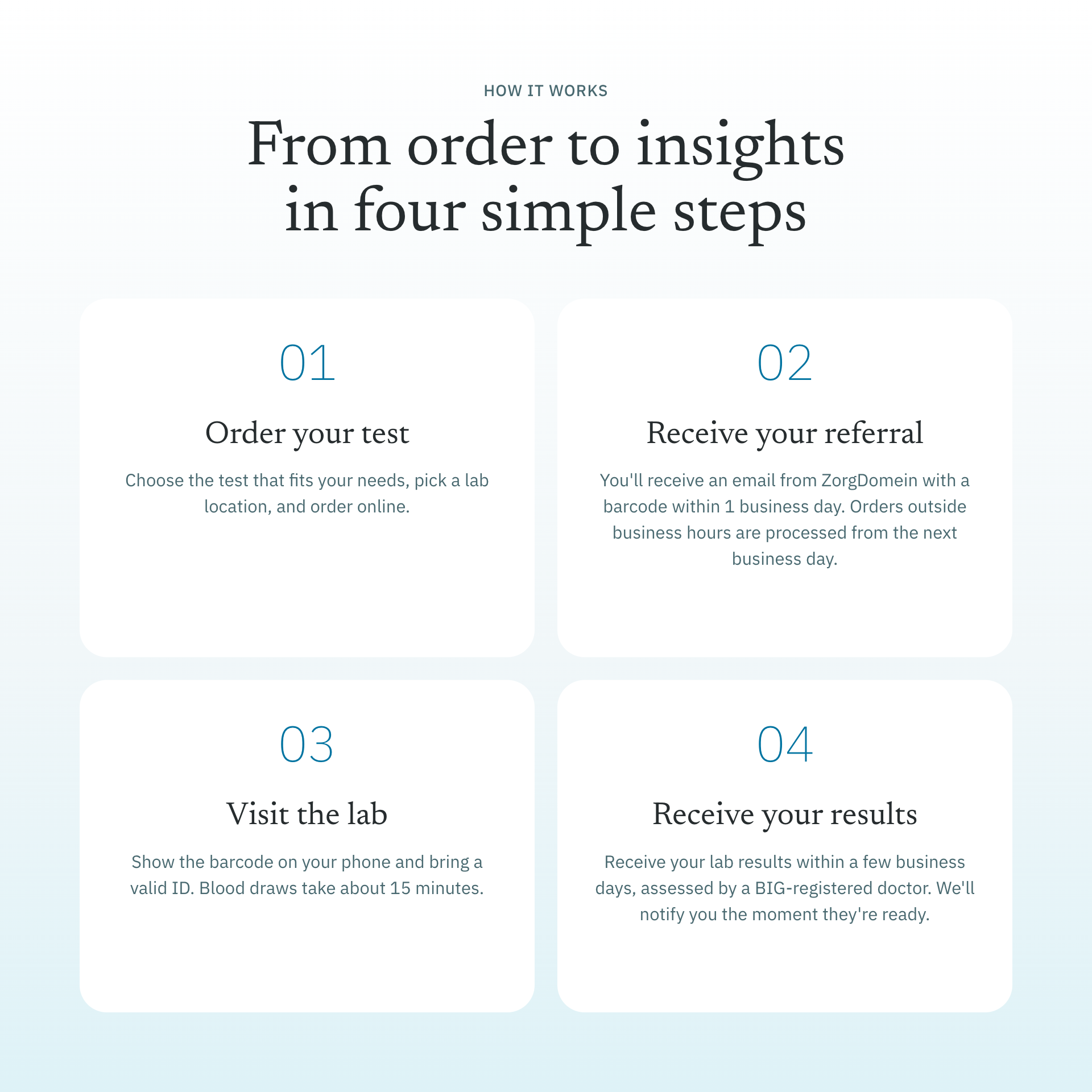
Your Health Journey in 4 Simple Steps
From order to insights, we've made health testing as easy as it should be.
Order Your Test
Choose the test that fits your needs, pick a lab location, and order online.
Receive Your Referral
You'll receive an email from ZorgDomein with a barcode within 1 business day. Orders outside business hours are processed from the next business day.
Visit the Lab
Show the barcode on your phone and bring a valid ID. Blood draws take about 15 minutes.
Receive Your Results
Receive your lab results within a few business days, assessed by a BIG-registered doctor. We'll notify you the moment they're ready.
Order Your Test
Choose the test that fits your needs, pick a lab location, and order online.
Receive Your Referral
You'll receive an email from ZorgDomein with a barcode within 1 business day. Orders outside business hours are processed from the next business day.
Visit the Lab
Show the barcode on your phone and bring a valid ID. Blood draws take about 15 minutes.
Receive Your Results
Receive your lab results within a few business days, assessed by a BIG-registered doctor. We'll notify you the moment they're ready.
Always a location near you
With 700+ certified phlebotomy points across the Netherlands.
What this checkup measures
This checkup includes 7 values for a clear picture of this system.
| No. | Biomarker | Unit | Turnaround |
|---|---|---|---|
| 01 | Estradiol (E2) Estradiol (E2) is the most potent form of estrogen, playing a key role in reproductive health, bone density, and cardiovascular function. Abnormal levels may indicate hormonal imbalances that your healthcare provider can help evaluate. | pmol/l | 2 days |
| 02 | FSH (Follicle Stimulating Hormone) Follicle-stimulating hormone (FSH) is produced by the pituitary gland and plays an essential role in reproductive function. It regulates egg development in women and sperm production in men. Abnormal levels may indicate changes in fertility or hormonal health. | U/L | 2 days |
| 03 | LH (Luteinizing Hormone) An LH blood test measures luteinizing hormone, a pituitary hormone essential for reproductive function. LH plays a key role in triggering ovulation in women and stimulating testosterone production in men. | U/L | 3 days |
| 04 | Prolactin A prolactin blood test measures the level of prolactin, a pituitary hormone primarily known for its role in lactation. Prolactin also influences reproductive function, immune regulation, and metabolic processes in both men and women. | ug/l | 2 days |
| 05 | SHBG (Sex Hormone Binding Globulin) SHBG stands for sex hormone binding globulin. It is a protein made by the liver. SHBG binds testosterone tightly and oestradiol somewhat more loosely. Hormone bound to SHBG cannot act in the tissues. SHBG therefore determines how much of your total testosterone is genuinely available. SHBG is not itself a sex hormone but a transport protein. Results are reported in nmol/l. Normal values differ by sex and by age, and in men SHBG rises as they get older. An SHBG should therefore be assessed alongside total testosterone, never on its own. | nmol/l | 5 days |
| 06 | Total Testosterone Total testosterone measures the combined amount of bound and free testosterone in the blood. As the primary androgen, testosterone may influence muscle mass, bone density, libido, mood, and energy levels in both men and women. | nmol/l | 2 days |
| 07 | TSH (Thyroid Stimulating Hormone) TSH is thyroid-stimulating hormone. The pituitary gland makes it, and uses it to drive your thyroid. At the laboratory that runs the test the usual adult range runs from 0.27 to 4.20 mE/L. A high TSH usually fits an underactive thyroid. A low value usually fits an overactive one. That direction feels inverted, and it is. TSH is the pituitary signal, not the thyroid hormone itself. Laboratories use slightly different limits from one another. Always read the reference value printed on your own result. And a single measurement is never a diagnosis. | mu/l | 2 days |
| Your result arrives once the slowest test is finished: 5 days. This is indicative; turnaround varies per laboratory. | |||
Preparation
-
Pause biotin
RequiredDo you take a supplement with biotin (vitamin B8, common in hair, skin and nail supplements)? Stop it 72 hours before the draw. Biotin interferes with the measurement of these values.
-
Have the draw in the morning
RequiredThese values vary over the day and peak in the morning. Have your blood drawn before 10:00, ideally between 07:00 and 09:00.
-
Arrive early and sit quietly first
RequiredThis value rises with stress and exertion. Arrive 30 minutes early and sit quietly before your blood is drawn.
-
Do you have a cycle? Pick the right day
RequiredIf you have a menstrual cycle, count the first day of your period as day 1 and have the draw on day 2 to 5. On hormonal contraception, or without a cycle, any day works.
- Water is always fine. Drink as usual beforehand, it makes the draw easier.
- Take your usual medication, unless your own doctor told you otherwise.
Extend this panel
Tests from the same field, run on the same sample. Same draw, no second appointment.
Related checkups
Discover more checkups for a fuller picture of your health.
Hormone checkup for men
A blood test with 7 hormone values for men — total testosterone, free testosterone, SHBG, estradiol, LH, prolactin and cortisol — for insight into your hormone balance.
Liver checkup
A blood test with 9 liver values — ALT, AST, GGT, alkaline phosphatase, bilirubin and albumin — for insight into how your liver is functioning.
Kidney checkup
A blood test with 5 kidney values — creatinine, eGFR, uric acid, sodium and potassium — for insight into how your kidneys are functioning.
This test not quite right?
Build your own blood test from 51+ individual biomarkers — choose exactly what you need.
Have a question?
Our team is happy to help. Ask your question and we'll respond as soon as possible.